


Vet Expectations
Vet Expectations
Choosing Your Puppy’s Veterinarian
You Are Not Just a Client. You Are Interviewing Them.
The first vet visit sets the tone for your puppy’s medical life.
This is not just a vaccine appointment.
This is the beginning of a long-term medical partnership.
And partnerships require informed consent, communication, and individualized care.
Puppies are not small adult dogs. Their immune systems are developing. Their bodies are growing rapidly. Their stress thresholds are lower. Timing and judgment matter.
You deserve a veterinarian who treats your puppy like an individual, like your child, not a protocol.
(Screenshot This Before You Go👇)
PUPPY FIRST VISIT CHECKLIST
Before vaccines are given, confirm:
☐ A full physical exam was performed
☐ Your puppy was weighed that day
☐ Temperature and hydration were assessed
☐ Heart and lungs were listened to
☐ Overall body condition was evaluated
☐ Your breeder’s vaccine record was reviewed
You will be provided with a detailed vaccine and deworming record outlining exactly what has already been administered, including dates and products used. Your veterinarian should review this before giving anything additional. Continuity of care matters.
Discuss vaccinations and ask:
☐ What exact vaccine is being given today?
☐ Is this core or lifestyle?
☐ Is this a 4-way DHPP or 5-way DHPP plus Lepto?
☐ Are we stacking multiple vaccines today?
☐ I am not comfortable with stacking so can they be spaced out?
☐ Will Rabies be given after the DHPP series is complete rather than with it?
☐ What reactions should I monitor for?
☐ What is your plan if a reaction occurs?
You should leave your appointment feeling heard and informed. A great vet appreciates educated owners and values open, respectful conversation about your dog’s health.
Mini Aussie Considerations:
Miniature Australian Shepherds, especially toy-leaning or smaller framed puppies, require thoughtful immune timing.
At eight weeks, average Mini Aussies weigh between 3 to 6 pounds. Vaccine dosing is standardized by volume, not weight, meaning a 3 pound puppy and a 20 pound dog receive the same dose. READ THAT AGAIN! A 3 pound puppy and a 20lb dog will get the same dosage.
Research also supports that smaller puppies have been known to experience stronger systemic responses simply due to body mass and immune maturity.
For Minis, consider:
• Avoiding unnecessary stacking at early appointments
• Ensuring strong weight gain before vaccination
• Spacing Rabies from other vaccines when possible
• Carefully evaluating the necessity of Leptospirosis
• Monitoring closely for facial swelling, lethargy, vomiting, or hives
From an immune-load standpoint, many thoughtful vets prefer:
• Finish the DHPP series through 14–16 weeks
• Then give rabies separately as their last annual vaccination
• Avoid stacking rabies with other vaccines
Why?
Rabies is a killed vaccine and tends to create a stronger inflammatory immune response than modified live vaccines like DHPP. While most puppies tolerate it well, separating it from other vaccines can reduce immune stress and make it easier to identify which vaccine caused a reaction if one occurs.
So what is the most conservative immune-friendly approach if legally allowed?
• DHPP at 8 weeks
• DHPP at 12 weeks
• DHPP at 16 weeks
• Rabies given 1 to 2 weeks after the final DHPP
That spacing allows the immune system to respond to each vaccine separately.
Mini Aussies are intelligent, sensitive dogs. Their medical care should reflect that sensitivity.
––––––––––––––
Golden Retriever Considerations
Golden Retrievers are larger framed puppies, often weighing 5-10 pounds at eight weeks with a rapid growth rate. While their body mass is greater, they are a breed known for immune-mediated conditions later in life.
Longevity and immune balance matter significantly in Goldens.
For Goldens, consider:
• Avoiding over-vaccination beyond core necessity
• Discussing long-term booster intervals
• Considering titer testing in adulthood
• Avoiding unnecessary annual repetition of vaccines with multi-year immunity
• Ensuring Rabies and core vaccines are not automatically stacked without discussion
Goldens already face higher lifetime risks for certain cancers and immune disorders. Thoughtful vaccine strategy supports immune balance over time.
––––––––––––––
Understanding Core vs Lifestyle
CORE vaccine:
DHPP protects against Distemper, Adenovirus, Parvovirus, and Parainfluenza. This is essential.
OPTIONAL Lifestyle vaccines include:
Leptospirosis
Bordetella
Canine Influenza
Lyme
These should ONLY be based on:
• Geographic prevalence
• Wildlife exposure
• Boarding or daycare attendance
• Hunting, farm exposure, rodents
• Standing water access like natural creeks, rivers, ponds with access to wildlife exposure, as well as, areas with heavy rainfall or flooding.
If your puppy will not be exposed to any of the above then they DO NOT NEED Lepto or Bordetella. Not every puppy needs every vaccine which is why they are optional.
Medicine Should Feel Collaborative
You are not being difficult by asking questions or denying your puppy unnecessary vaccinations.
You are being responsible.
The best veterinarians:
• Welcome informed owners
• Explain recommendations clearly
•. Discuss risks and benefits openly
• Individualize care for your breed and size
• Respect spacing when medically appropriate
• Respect your research, your concerns, and your right to make informed decisions for your dog.
The goal is not necessarily fewer vaccines.
The goal is appropriate vaccines, at appropriate times, for that individual dog.
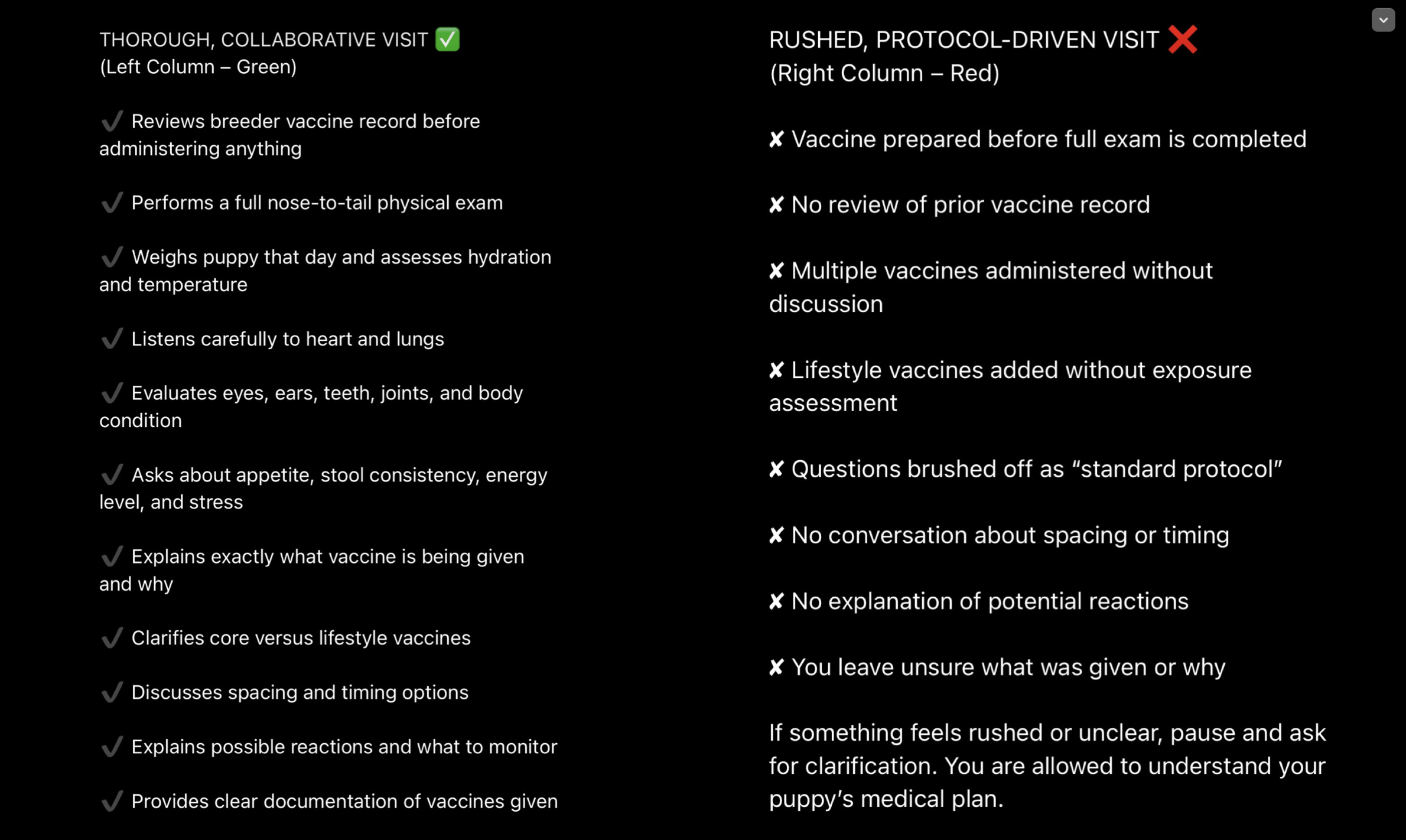
What a Thorough First Visit Looks Like ✅ -vs- What a Rushed Appointment Can Look Like ❌
Final Thoughts-
Your veterinarian is a medical professional. However, most veterinarians are trained to treat a broad spectrum of species, breeds, sizes, and life stages. They do not have extensive hands-on experience with neonates, young puppies, or breed-specific considerations. That is why collaborative communication matters.
If you ever feel unsure, overwhelmed, or need clarification about your puppy’s care plan, please reach out to us. We know our lines, their genetics, their early development, and the protocols we began before they ever left our home. We are always here to help you think through decisions.
But you are your puppy’s daily observer.
You track their weight.
You see their stress levels.
You know their genetics.
You know when something feels off.
A strong veterinary relationship feels like a partnership, not pressure, not confusion, not dismissive.
Ask questions.
Understand what’s being administered.
Advocate respectfully.
Choose collaboration over blind protocol.
Your puppy’s health is not a one-day appointment.
It is a lifetime responsibility.
And you are capable of handling it.
Evidence-Based Resources
American Animal Hospital Association, AAHA. 2022 AAHA Canine Vaccination Guidelines. Lakewood, CO: AAHA Press. Provides evidence-based recommendations on core vaccines, booster timing, vaccine types, and adverse event considerations.
World Small Animal Veterinary Association, WSAVA. 2016 WSAVA Guidelines for the Vaccination of Dogs and Cats. Global Veterinary Community. International consensus guidelines addressing maternal antibody interference, vaccine timing, and immune system development in puppies.
Centers for Disease Control and Prevention, CDC. Leptospirosis in Dogs. U.S. Department of Health and Human Services. Outlines environmental risk factors including wildlife exposure, rodents, standing water, rainfall, and flooding.
American Veterinary Medical Association, AVMA. Vaccination Principles and Recommendations. Schaumburg, IL. Explains vaccine safety monitoring, risk benefit assessment, and informed consent standards in veterinary medicine.
Morris Animal Foundation. Golden Retriever Lifetime Study. Ongoing prospective study evaluating cancer and immune related disease prevalence in Golden Retrievers.
Day, M.J., Schultz, R.D. Veterinary Immunology and Immunopathology. Peer reviewed literature detailing neonatal immune immaturity and immune system development in puppies.
Reference for immune maturity in puppies
M Pereira et al., Development of dog immune system: from in uterus to elderly (2019), MDPI. This article highlights that puppies are born with an immature immune system that develops as they age, contributing to differences in systemic immune responses early in life.